
Introduction: More Than Just a Spec Sheet
The Google Pixel 8 arrived with a promise that extends far beyond its hardware. While it packs a capable 6.2-inch display, the powerful Tensor G3 chip, and a proven camera system, its most compelling feature is a commitment: seven years of software updates. In a market where most Android phones are forgotten after three, this pledge reframes the entire value proposition. But does this long-term vision come at the expense of day-to-day excellence?
Having spent significant time with the device, it’s clear the Google Pixel 8 is a story of refined pragmatism. It doesn’t chase every spec headline. Instead, it focuses on delivering a cohesive, intelligent, and polished user experience powered by Google’s standout AI software. This review will break down where it shines, where it merely competes, and help you decide if it’s the right flagship for your needs and budget.
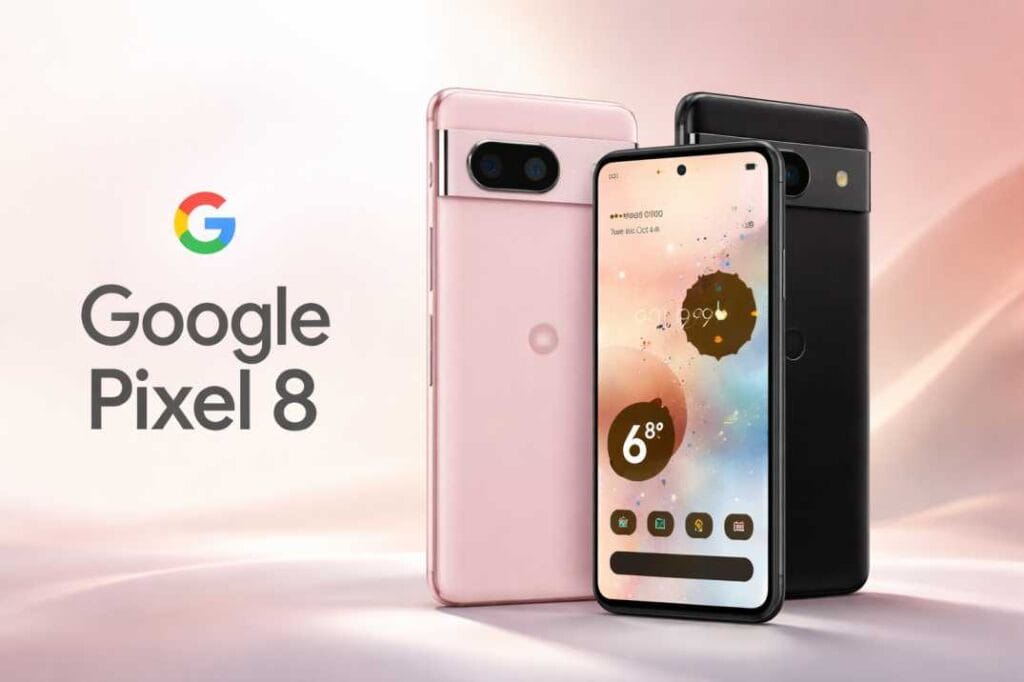
Design & Build: A Refined, Compact Companion
Google has steadily refined the Pixel’s design language, and the Pixel 8 represents its most ergonomic and friendly form yet.
- Perfectly Proportioned: With dimensions of 150.5 x 70.8 x 8.9 mm and a weight of 187g, it’s notably more compact and lighter than its Pixel 6 and 7 predecessors. The width, in particular, has shrunk to 70.8mm, making one-handed use comfortable and secure—a return to the praised ergonomics of the Pixel 5.
- Premium Materials: It features a glass front and back, both protected by Corning Gorilla Glass Victus, framed by satin-finished aluminum. The rounded corners and softer edges contribute significantly to the in-hand feel. It also carries a robust IP68 rating, making it dust-tight and waterproof for up to 30 minutes in 1.5 meters of water.
- The Camera Bar: The iconic camera visor remains, now with a polished aluminum finish. A minor gripe is that this bar protrudes noticeably and the polished edges can be prone to scuffing over time.
Available in Obsidian (black), Hazel (gray/green), Rose (pink), and Mint (light blue-green), the Pixel 8 offers subtle and stylish color choices.
Display & Audio: Bright, Smooth, and Immersive
The display is one of the most significant upgrades from the Pixel 7.
- Actua Display Quality: The 6.2-inch FHD+ (1080 x 2400) OLED panel is a joy to use. It now features a smooth 120Hz refresh rate (up from 90Hz), making scrolling and animations fluid.
- Extreme Brightness: With a peak HDR brightness of up to 2000 nits and a sustained high brightness mode (HBM) of 1400 nits, visibility under direct sunlight is excellent. This is a substantial jump that brings it in line with the best.
- Audio Experience: The stereo speaker setup provides clear and loud audio, suitable for media consumption and calls. As is standard for flagships, there is no 3.5mm headphone jack. However, it supports high-quality audio over Bluetooth 5.3 with aptX HD codec support.
Performance & AI: The Power of Google Tensor G3
At its core is the Google Tensor G3 system-on-a-chip (4nm process), paired with 8GB of LPDDR5X RAM and your choice of 128GB or 256GB of non-expandable UFS 3.1 storage.
- Real-World Speed: In daily use, the performance is snappy and more than sufficient for social media, productivity apps, and multimedia. It handles most games well, though it may not sustain peak frame rates in the most graphically intensive titles compared to some Snapdragon-powered rivals.
- Where It Truly Excels: On-Device AI. The Tensor G3 is built to leverage Google’s AI advancements. This enables features that feel magical and are processed privately on your device:
- Call Clear: Dramatically reduces background noise on phone calls.
- Magic Eraser & Photo Unblur: Remove unwanted objects or fix blurry photos in Google Photos.
- Live Translate: Real-time translation for captions and audio in supported apps.
- Connectivity: It is a well-connected device, supporting the latest Wi-Fi 6e/7 standards and a comprehensive array of 5G bands for excellent network compatibility in India and abroad.
Camera System: Computational Photography Champion
The Pixel camera philosophy has always been “software first,” and the Pixel 8 continues this legacy with brilliant results.
- Hardware Specs: It sports a dual-camera array on the back:
- Main Camera: 50MP wide sensor (producing 12.5MP images by default via pixel-binning), f/1.7 aperture, with Optical Image Stabilization (OIS) and Dual Pixel PDAF.
- Ultrawide Camera: 12MP sensor, f/2.2 aperture, with a 126˚ field of view and autofocus (enabling decent macro shots).
- Front Camera: A 10.5MP ultrawide lens for selfies and group shots.
- AI-Powered Software Magic: This is where the Pixel separates itself. Exclusive features like Best Take (combines multiple shots to get everyone’s best expression), Magic Editor (generative AI to reposition subjects or alter backgrounds), and Audio Magic Eraser (removes distracting background noise from videos) are incredibly powerful and user-friendly.
- Image Quality: Photos are consistently excellent with vibrant colors, superb dynamic range (especially with Ultra HDR), and incredible detail. Low-light performance via Night Sight is top-tier. The lack of a dedicated telephoto lens is felt, but the Super Res Zoom digital zoom does a respectable job up to 8x. For video, it captures stable 4K footage at up to 60fps with support for 10-bit HDR.
Battery Life & Charging: All-Day Power with Caveats
The Pixel 8 is equipped with a 4575 mAh battery.
- Battery Life: In real-world testing, it reliably delivers between 1 to 1.5 days of use on a single charge with moderate usage. It’s not class-leading, but it’s sufficient for most users. Google’s Adaptive Battery technology helps optimize power for your habits over time.
- Charging Speeds: It supports 27W wired fast charging (a Google 30W charger is sold separately). From empty, it can reach about 50% in 30 minutes, with a full charge taking roughly 1 hour and 36 minutes. It also supports 18W wireless charging and convenient reverse wireless charging (Battery Share) to top up your earbuds or another phone.
- Efficiency Note: Independent tests from DXOMARK give the Pixel 8 a global battery score of 103, noting its performance is good but not exceptional among flagships. Its annual energy consumption is estimated at around 4.1 kWh.
Software & Support: The Unbeatable Long-Term Promise
This is the Pixel 8’s killer feature.
- Clean Android 14: The phone runs a clean, bloatware-free version of Android 14 with exclusive Pixel-only features and intelligent additions like Circle to Search.
- The 7-Year Guarantee: Google promises seven years of major Android OS upgrades, security updates, and Feature Drops. This means the Pixel 8 will be supported all the way to Android 21 in 2030. This is unprecedented in the Android world and matches or exceeds Apple’s typical support window.
- Long-Term Value: This commitment transforms the phone from a short-term gadget into a long-term investment. It promises enhanced security, new features, and a modern software experience for years, drastically improving its resale value and reducing electronic waste.
Google Pixel 8 vs. The Competition
Choosing a phone often comes down to comparing alternatives. Here’s how the Pixel 8 stacks up against its closest relatives.
| Feature | Google Pixel 8 | Google Pixel 8a |
|---|---|---|
| Display | 6.2″ Actua OLED, 120Hz, Gorilla Glass Victus | 6.1″ Actua OLED, 120Hz, Gorilla Glass 3 |
| Build & Durability | IP68 dust/water resistance | IP67 dust/water resistance |
| Main Camera | 50MP Octa PD (Larger, more light-sensitive sensor) | 64MP Quad PD |
| Charging | 27W wired, 18W wireless, Battery Share | 18W wired, 7.5W wireless |
| Starting Price | Higher | More Affordable |
The Verdict: The Pixel 8 offers a more premium build (IP68, better glass), slightly faster wired and wireless charging, and Battery Share. If these premium touches matter to you, the Pixel 8 is worth the upgrade. If you want the core Pixel AI and camera experience on a budget, the 8a is phenomenal.
Pixel 8 vs. Pixel 8 Pro: The Ultimate AI Powerhouse
The Pro model is for users who want everything Google has to offer.
The Verdict: Choose the Pro if you are a photography/videography enthusiast who needs a telephoto lens and the absolute best video quality (Video Boost). The larger, brighter LTPO display and extra RAM are also significant perks for power users.
Wondering how other brands approach the flagship segment? Our comparison of the [Samsung Galaxy S24 vs. OnePlus 12] explores different takes on Android excellence.
Google Pixel 8 vs. The Competition: How It Stacks Against Samsung, Apple & OnePlus
Choosing a smartphone in the premium segment means navigating a field of exceptional contenders. The Google Pixel 8 carves out its niche not through brute force specs, but through a distinct philosophy centered on AI, software purity, and long-term value. To see where it truly stands, let’s put it head-to-head with its key rivals: the Samsung Galaxy S24, the Apple iPhone 15, and the OnePlus 12.
This comparison will move beyond basic spec sheets to examine the real-world user experience, unique strengths, and compromises each device presents.
Google Pixel 8 vs. Samsung Galaxy S24: The Android Heavyweight Bout
This is the most direct comparison for Android purists. Both run Android, but their approaches are markedly different.
| Feature | Google Pixel 8 | Samsung Galaxy S24 | The Verdict |
|---|---|---|---|
| Software & AI | Clean Android 14, 7 years of updates, exclusive AI features (Call Clear, Magic Editor). | One UI 6.1 with Samsung Dex, Galaxy AI features (Circle to Search, Live Translate), 7 years of updates. | A draw with different flavors. Pixel offers purer Android and more creative AI. Samsung offers deeper customization and desktop functionality. Both promise unparalleled long-term support. |
| Camera | 50MP main + 12MP ultrawide. Superior computational photography, Best Take, Magic Editor. No telephoto. | 50MP main + 12MP ultrawide + 10MP 3x telephoto. Versatile hardware, excellent video, strong post-processing. | Pixel for point-and-shoot magic, Samsung for versatility. The Pixel’s software produces consistently stunning stills easily. Samsung’s telephoto lens gives it a clear edge for zoom, and its video is often more polished. |
| Performance | Google Tensor G3. Excellent for daily tasks and AI, but can warm under heavy, sustained loads. | Snapdragon 8 Gen 3 (or Exynos). Higher peak performance, better sustained gaming performance, cooler operation. | Advantage Samsung. The Snapdragon 8 Gen 3 is a more powerful and efficient chipset, making the S24 the better choice for demanding mobile gamers. |
| Display | 6.2″ Actua Display, 120Hz, 2000 nits HDR brightness. | 6.2″ Dynamic AMOLED 2X, 120Hz (1-120Hz LTPO), 2600 nits peak brightness. Slightly flatter design. | Slight edge to Samsung. The LTPO panel is more power-efficient, and it gets noticeably brighter. Both are among the best. |
| Ecosystem | Integrates seamlessly with Google services (Photos, Assistant, Drive). | Part of the vast Samsung ecosystem (Galaxy Watch, Buds, Tabs, SmartThings). | Depends on your loyalty. If you live in Google’s world, Pixel is native. If you own other Samsung devices, the S24 connects effortlessly. |
| Price (India) | Starts at approx. ₹75,999. | Starts at approx. ₹79,999. | Pixel 8 often has better street prices and promotions, offering slightly better value. |
Bottom Line: The Samsung Galaxy S24 is the more powerful, versatile, and cooler-running device with a critical telephoto lens. The Google Pixel 8 fights back with a more intuitive AI experience, arguably better main camera processing for most people, and often a more attractive price. Choose the S24 for hardware prowess and zoom; choose the Pixel for AI smarts and photographic consistency.
For a deeper dive into this specific rivalry, explore our detailed comparison of the [Samsung Galaxy S24 vs. Google Pixel 8].
Google Pixel 8 vs. Apple iPhone 15: The Ecosystem Crossroads
This comparison is less about specs and more about choosing an operating system and ecosystem. The Pixel 8 is Android’s answer to the base iPhone.
| Feature | Google Pixel 8 | Apple iPhone 15 | The Verdict |
|---|---|---|---|
| Software & Support | Android 14 with 7-year update promise. More open, customizable. | iOS 17 with 6-7 year update promise. Tightly integrated, polished, but locked down. | Personal preference. Android offers freedom; iOS offers simplicity and unmatched ecosystem cohesion. Both promise excellent longevity. |
| Camera | 50MP main + 12MP UW. AI-powered features lead still photography. Magic Editor, Best Take. | 48MP main + 12MP UW. Superior video quality, Photographic Styles, proven consistency. | Pixel for stills, iPhone for video. The Pixel’s computational tricks are more advanced. The iPhone delivers better dynamic range and stabilization in video, and its camera system is incredibly reliable. |
| Performance | Google Tensor G3. Optimized for AI tasks. | Apple A16 Bionic. Industry-leading raw performance and efficiency. | Clear win for iPhone. The A16 Bionic is in a different league for power and efficiency, offering cooler operation and faster app/game performance. |
| Display & Design | 120Hz smooth display. Aluminum frame with glossy glass back. | Super Retina XDR display (60Hz only). Color-infused glass back & aerospace-grade aluminum frame. | Mixed. Pixel’s 120Hz is smoother, but iPhone’s build feel and brightness are superb. The 60Hz refresh on the iPhone 15 is its biggest hardware drawback. |
| Ecosystem | Best with Google services (YouTube, Gmail, Google Home). | Unbeatable with other Apple products (Mac, iPad, Apple Watch, AirPods). | iPhone dominates here. If you own other Apple devices, the seamless handoff and integration are a massive lock-in advantage. |
| Price (India) | Starts at approx. ₹75,999. | Starts at approx. ₹79,900. | Very closely matched. Value depends on which ecosystem’s features you’ll use. |
Bottom Line: The Apple iPhone 15 offers a more powerful chip, a superior ecosystem (if you’re in it), and best-in-class video. Its 60Hz display feels outdated. The Google Pixel 8 counters with a smoother screen, more innovative AI camera tools for photos, and the flexibility of Android. This choice fundamentally boils down to iOS vs. Android.
Google Pixel 8 vs. OnePlus 12: The Value Powerhouse Challenge
OnePlus has built its reputation on offering top-tier specs at a competitive price. The OnePlus 12 is a spec monster that challenges the Pixel’s more nuanced approach.
| Feature | Google Pixel 8 | OnePlus 12 | The Verdict |
|---|---|---|---|
| Software | Clean, bloat-free Android with 7 years of updates. Timely security patches. | OxygenOS 14 (close to stock, but with OnePlus customizations). Promises 4 OS updates & 5 years of security patches. | Major win for Pixel. Google’s clean software and much longer support window are defining advantages for long-term users. |
| Camera | Dual-camera system. Relies on best-in-class computational photography. | Triple Hasselblad-tuned system (LYT-808 main + 64MP 3x telephoto + 48MP UW). Superior hardware versatility. | Hardware vs. Software. OnePlus 12 has the far better hardware kit, including a crucial telephoto lens. The Pixel still often wins in point-and-shoot consistency, especially in challenging lighting, thanks to its software. |
| Performance & Battery | Tensor G3, 4575 mAh, 27W charging. Good daily performance. | Snapdragon 8 Gen 3, 5400 mAh, 100W wired charging. A performance and endurance powerhouse. | Dominant win for OnePlus. It offers significantly better performance, nearly double the charging speed, and much longer battery life. This is its core strength. |
| Display | 6.2″ FHD+, 120Hz, 2000 nits. Excellent quality. | 6.82″ QHD+ LTPO, 1-120Hz, 4500 nits peak. A larger, sharper, brighter panel. | OnePlus 12 wins on specs. It’s simply one of the best displays on any smartphone. The Pixel’s is great, but smaller and less sharp. |
| Build | IP68 rating, compact, ergonomic. | IP65 rating, larger form factor. | Pixel is more durable and pocket-friendly. The IP68 rating is a meaningful advantage over IP65. |
| Price (India) | Starts at approx. ₹75,999. | Starts at approx. ₹64,999. | OnePlus 12 offers dramatically more hardware for less money. |
Bottom Line: The OnePlus 12 is the clear winner on pure hardware specifications. You get a faster chip, a vastly bigger battery with blistering charging, a superior display, and a more versatile camera system—all for a lower starting price. The Google Pixel 8 reclaims ground with its compact IP68 build, cleaner software, industry-leading update promise, and a camera that often produces better results with less effort. Choose OnePlus 12 for max specs per rupee; choose Pixel 8 for long-term software value and AI-driven simplicity.
Comparison Summary Table
| Google Pixel 8 | Samsung Galaxy S24 | Apple iPhone 15 | OnePlus 12 | |
|---|---|---|---|---|
| Key Strength | AI Software & 7-Year Support | Hardware Versatility & Performance | Ecosystem & Video Quality | Raw Specs & Charging Speed |
| Camera Verdict | Best point-and-shoot stills | Most versatile system | Best video, reliable stills | Best hardware on paper |
| Performance | Good (AI-focused) | Excellent (All-round) | Exceptional (Leading) | Excellent (All-round) |
| Software Support | 7 Years (Best in Class) | 7 Years (Best in Class) | 6-7 Years (Excellent) | 4 Years (Good) |
| Display | Great (120Hz, very bright) | Excellent (LTPO, brightest) | Great (but 60Hz only) | Best (QHD+, LTPO, brightest) |
| Battery & Charging | Good (27W charging) | Good (25W charging) | Good (20W charging) | Exceptional (100W charging) |
| Ideal For | The AI enthusiast & long-term thinker | The power user who wants it all | The Apple ecosystem user | The spec-driven value seeker |
Final Competitive Analysis
The Google Pixel 8 exists in a competitive sweet spot defined by intelligence over brute force. It doesn’t “win” on raw specifications against rivals like the OnePlus 12 or the Samsung Galaxy S24. Instead, it wins on user experience and future-proofing.
Its real competitors are not just other phones, but consumer attitudes. It challenges the notion that you need the biggest number (megapixels, wattage, RAM) to have the best phone. For a specific user—one who prizes a phenomenal camera that works effortlessly, a clean and long-supported software experience, and helpful AI integrated into daily tasks—the Pixel 8 is not just competitive; it is arguably without a direct rival.
However, if your priorities are mobile gaming, optical zoom photography, the fastest possible charging, or deep immersion in the Samsung or Apple ecosystems, a compelling alternative exists that may better suit your needs. The Pixel 8’s genius is in knowing exactly what it is and serving that vision flawlessly.
Verdict: Who Should (and Shouldn’t) Buy It
The Google Pixel 8 is a brilliantly refined smartphone that makes a compelling case not just for what it is today, but for what it will be for the next seven years.
Buy the Google Pixel 8 if:
- You value a clean, long-lasting software experience above all else.
- You want a compact, ergonomic flagship that’s easy to use one-handed.
- You love photography but don’t want to fiddle with manual settings—its point-and-shoot AI camera is unbeatable.
- You appreciate unique, helpful AI features that feel genuinely useful.
Consider other options if:
- You need the absolute fastest charging available (look at Chinese brands with 65W+ charging).
- You are a mobile gamer who needs sustained peak gaming performance (flagships with the latest Snapdragon might edge it out).
- Your photography heavily relies on optical telephoto zoom (the Pixel 8 Pro or other Pro models are better suited).
- You have a very tight budget (the Pixel 8a or previous-generation sales offer better value).
For the right user, the Pixel 8 isn’t just a phone; it’s a reliable, intelligent companion built to last. Its combination of smart software, a stellar camera, a compact design, and an unmatched update promise makes it one of the most sensible and satisfying flagship purchases available today.
Frequently Asked Questions (FAQs)
Does the Google Pixel 8 come with a charger in the box?
No, the Pixel 8 does not include a charger in the box. It comes with a USB-C to USB-C cable. You will need to purchase a compatible USB Power Delivery (PD) charger separately, with Google recommending its 30W charger for the fastest speeds.
Is the Google Pixel 8 good for gaming?
Yes, it is capable of handling most games very well. The Tensor G3 chip and 120Hz display provide a smooth experience. However, for the most demanding games at max settings, it may not sustain the highest possible frame rates as consistently as some competitors with dedicated gaming-focused chipsets.
What does ‘7 years of updates’ actually include?
Google promises seven years of major Android version updates (e.g., Android 15, 16, etc.), security patches released monthly, and Pixel Feature Drops that bring new functionality and enhancements quarterly. This support is guaranteed until at least October 2030.
How does the Pixel 8’s battery life compare to the Pixel 7?
The Pixel 8 has a larger battery (4575 mAh vs. ~4300 mAh in the Pixel 7) and a more efficient Tensor G3 processor. Users and reviewers generally report a modest but noticeable improvement in battery life, often getting through a full day with more headroom to spare.
Is the Pixel 8 dual SIM?
Yes, the Pixel 8 supports dual SIM functionality through a hybrid setup: one physical Nano-SIM tray and one eSIM. This allows you to use two phone numbers or plans simultaneously
Pingback: MagSafe Wireless Charger: Ultimate Guide & Best Picks for 2025
Pingback: Google Pixel 9 Pro XL Case Guide 2025: Top Picks Tested & Compared